
Private sector lobbying in relation to social regulation often lacks transparency, making it extremely difficult to assess its influence. To overcome this challenge, Social LobbyMap (SLM) analyses company and trade association lobbying activities in relation to human rights and labour standards, with the aim of increasing transparency and accountability. This blog post examines the lobbying conducted by apparel sector entities in relation to the EU’s Corporate Sustainability Due Diligence Directive (CSDDD) and the subsequent Omnibus I proposal.1
Despite the apparel sector being widely recognised as high-risk for human rights violations, and many of the sector’s leading entities having spent years developing due diligence systems, a relatively small number of apparel entities engaged publicly on the CSDDD. For example, the full analysis covered 16 apparel entities (eight companies and eight trade associations). Of these, 15 were found to have lobbied publicly during the European Commission’s official CSDDD consultation,2 through submissions, position papers, or joint statements, while one entity appeared only in relation to the Omnibus I proposal. Of the 15 entities that engaged on the CSDDD, 11 continued their lobbying efforts on the Omnibus. While the entities that did participate demonstrated moderate levels of engagement intensity (discussed below), there was a notable absence of many large, common brands. It is possible that the sector focused on other avenues of engagement with legislators [3], but it is interesting that so few apparel entities took the opportunity to engage directly with the public consultation process.
However, where lobbying was identified, the positions of apparel sector entities were overall more supportive of strong due diligence standards than the majority of other sectors previously analysed by SLM [4]. The supportive lobbying was led by a few prominent entities that consistently demonstrated strong support, recognising that “focusing on solely voluntary regulation for responsible business conduct has shown to be insufficiently effective, and typically lacking the required leverage to achieve the necessary social and environmental changes.[5]
Taken together, the research finds a small number of apparel sector entities engaged publicly, but those that did lobby were relatively active and supportive. Given the sector’s experience with human rights due diligence, supportive apparel entities could have played a more visible role in the consultation process.
General findings
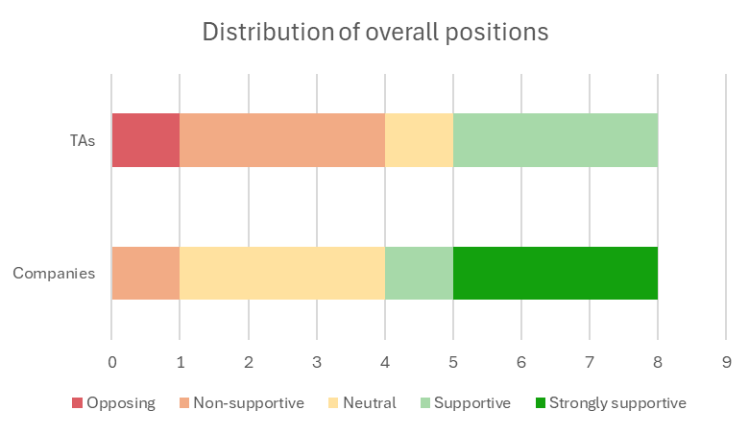
[Figure 1: Distribution of the apparel sector’s trade association and company lobbying positions on the CSDDD and Omnibus 1 proposal]
Overall, the apparel sector had an average organisational score of 56 [6] placing it in the neutral category and ahead of most other sectors analysed by SLM, including finance, energy, oil and gas, metals and mining, business services, and cross-sectoral associations. The only sector analysed by SLM that has scored higher than the apparel sector is food products, primarily led by support for the CSDDD through joint letters organised by the Voice Network and Cocoa Coalition. This relatively stronger performance of the apparel and cocoa sectors may reflect longer experience with human rights due diligence, as well as a desire among some companies to level the playing field.
Company and trade association misalignment
As shown in Figure 1, apparel trade associations tended to take more negative positions than those of individual companies. However, the division between company and trade association positions in the apparel sector is smaller than in many other sectors analysed by SLM, where trade associations often showed stronger opposition. This is partly due to some apparel trade associations, such as the Ethical Trading Initiative, Fair Wear Foundation, and Policy Hub Circularity for Apparel and Footwear (Policy Hub), taking more progressive positions and demonstrating their support for the CSDDD.
Yet, some clear misalignments remain. For example, Primark, the most supportive entity amongst apparel entities, has a 34-point gap between its organisational score and its relationship score [7]. This indicates that while the trade associations that Primark is a member of (Cascale and Policy Hub), are not opposed to the directive, they are still not as supportive as Primark itself.
Provisions that received the most and least support
Support amongst apparel sector entities varied significantly depending on the topic in question. The strongest backing was seen for making human rights due diligence a legal requirement (captured by SLM indicator Q1.1). The vast majority of apparel entities supported this measure, with only two exceptions: EURATEX, which adopted a neutral position, and the Confederation of the German Textile and Fashion Industry, which opposed it.
In contrast to this, provisions on judicial enforcement and civil liability (indicator Q2.5) attracted high engagement, but the positions were much less supportive. Of the 13 entities that engaged on the topic, eight were either not supportive or oppositional. This suggests that while due diligence is widely accepted generally, support decreases when it comes to provisions that would increase legal accountability.
Further, provisions on stakeholder engagement (captured by SLM Theme 4), received the least levels of engagement, which is consistent with the overall research findings of SLM. Of the 11 entities that did engage on Theme 4, over half were oppositional. Only three entities (Primark, Fair Wear Foundation, and Ethical Trading Initiative) demonstrated their support for stakeholder engagement, demonstrating that their progressive views remained consistent throughout the entirety of the consultations, regardless of the topics and provisions in question.
Lobbying intensity and continuity
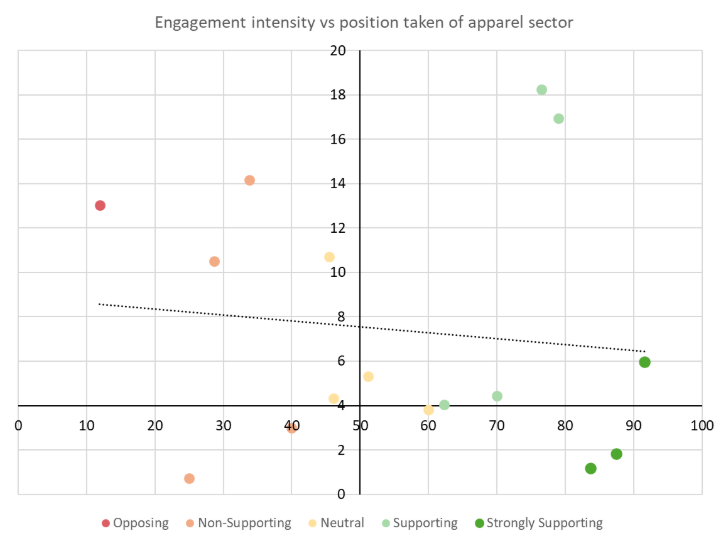
[Figure 2: Distribution of engagement intensity by individual apparel entity scores ranging from opposing (0) to supporting (100)]
As previously mentioned, despite a limited number of apparel entities engaging on the CSDDD and Omnibus, the sector’s average engagement intensity score is moderate and comparable to other previously analysed sectors. However, apparel sector entities that hold an opposing or unsupportive position on the CSDDD have a slightly higher average engagement intensity score (8.3) when compared to those that hold supportive or strongly supportive positions (7.5) [8]. This is consistent with other SLM analyses, which found that oppositional and unsupportive voices were much louder and more active than those that were supportive. The apparel sector, however, has a couple of active supportive voices, mainly the Ethical Trading initiative and Fair Wear Foundation, which have the highest engagement intensity scores amongst the sector. This helps to slightly balance the higher activity of the unsupportive entities and to ensure that the various perspectives of the sector are being heard more evenly.
Further, the apparel sector saw relatively consistent lobbying on both the CSDDD and the Omnibus. Of the 15 entities that lobbied on the CSDDD, 11 continued lobbying publicly following the Omnibus I proposal, including the six entities that scored the highest for their positions on the CSDDD. This indicates that the entities that are supportive of mandatory human rights due diligence were not just expressing support for the CSDDD at a time that would be beneficial for them based on public opinion. Rather, their expression of support was genuine and was followed by opposition to the weakening of standards proposed under the Omnibus.
Conclusion
The apparel sector’s lobbying on the CSDDD shows a mixed picture. Compared to the majority of other industries, apparel entities demonstrate greater support for mandatory human rights due diligence. This is largely a result of individual companies, which are often more supportive than associations, being more active as well as two trade associations, Ethical Trading Initiative and Fair Wear Foundation, taking supportive views and lobbying intensely throughout the legislative process. This is in contrast to other sectors, which primarily saw oppositional trade associations leading lobbying activities. This likely reflects the apparel sectors’ years of pressure over labour rights and supply chain risks, existing efforts by companies to address this, and the desire for a level playing field.
However, support weakens in relation to provisions that would increase enforceability and accountability. Indicators that cover civil liability and stakeholder engagement received less support and more opposition, particularly from trade associations. This suggests that while due diligence is generally more widely accepted by the apparel sector, there is still resistance by some entities to support measures that would increase protections for affected rightsholders and hold companies accountable.
The analysis finds that the overall general support from apparel sector entities that engaged on the CSDDD is contrasted with limited participation in the EU’s CSDDD consultations, particularly among major industry brands. While the entities that did engage demonstrated moderate levels of engagement intensity, the small number of participants meant that the sector’s voice was less prominent than it could have been. Given the sector’s knowledge and experience with human rights due diligence, companies and trade associations are well positioned to contribute to regulatory consultations and should use their platforms to amplify support. This is particularly important given that oppositional and unsupportive entities across the apparel sector have higher levels of engagement and have lobbied more loudly, disproportionately shaping the sector’s position.
Please see the Social LobbyMap methodology for further explanation of the various indicators and scores that are mentioned throughout this post. Please further note this disclaimer when reviewing the data referenced in the text above https://sociallobbymap.org/disclaimer/.
[1] For a broader analysis of lobbying on these two legislations, please see the previous publications at the bottom of the Social LobbyMap About page, https://sociallobbymap.org/about/
[2] The CSDDD underwent three public consultation phases under the European Commission’s “Sustainable Corporate Governance” initiative, conducted from 30 July to 8 October 2020, from 26 October 2020 to 8 February 2021, and from 28 March to 23 May 2022, https://ec.europa.eu/info/law/better-regulation/have-your-say/initiatives/12548-Sustainable-corporate-governance_en
[3] For example, some entities that submitted responses to the official EU consultations also held meetings with the European Commission on the CSDDD or Omnibus proposal, including C&A, Fair Wear Foundation, Federation of the European Sporting Goods Industry, and H&M Group. It is possible that other apparel sector entities held meetings or signed joint letters that were not captured by this analysis.
[4] For a further analysis of other sectors assessed by SLM and their positions, please see The lobbying effect: How corporate influence shaped the EU’s sustainability Omnibus proposal, A Social LobbyMap Analysis, EIRIS Foundation, October 2025, https://sociallobbymap.org/wp-content/uploads/2025/09/EIR03-Omnibus-Document-v2.pdf.
[5] Fair Wear Foundation’s response to Q2 in the 2nd phase of the European Commission’s CSDDD consultation.
[6] For an explanation of scores and SLM’s methodology, please see “Table 2: Key LobbyMap Metrics”, The LobbyMap
Methodology, Influencemap, lobbymap.org/briefing/LobbyMap-Methodology-24422. While Influencemap scores entities in
relation to climate and environmental policies, SLM uses the same methodology but applies it to social policy and standards.
[7] See above note 6
[8] See above note 6